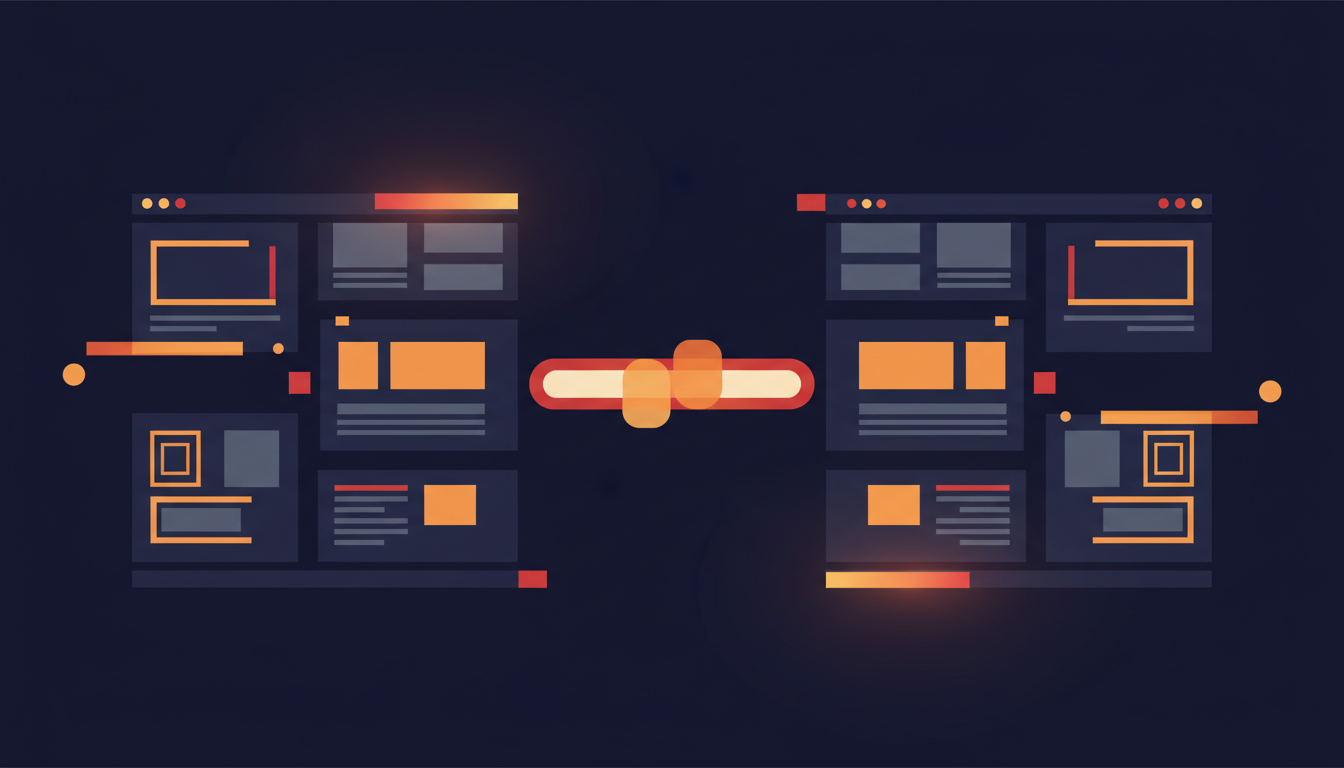
A bilingual Arabic English website serves two audiences on one platform: Arabic-speaking customers, partners and staff, and English-speaking clients, investors or head-office teams. The common mistake is to build the site in English and add an Arabic version later by translating the text. That approach usually breaks the layout, weakens search visibility in Arabic and leaves half the pages untranslated. The decisions that matter most are made before any design work begins.
Decide the site structure before design
The first decision is how the two languages live inside the site. Most businesses choose one of three patterns:
- Language prefixes on one domain, such as /ar/ and /en/ paths. This keeps authority in one place and is the most common choice for companies with one brand.
- Separate subdomains, such as ar.example.com. This is easier to hand to a different team but splits search signals.
- Separate sites with different content. This suits companies whose Arabic and English audiences need different offers, not just different words.
Whichever pattern you pick, every page needs its own URL in each language, a language switcher that goes to the matching page rather than the home page, and a clear fallback when a page has not been translated yet.
Plan right-to-left layout as a design system, not a patch
Arabic reads right to left, so the layout should mirror. Navigation sits on the right, text aligns right, and the order of cards, steps and form fields reverses. Designers often mirror the page but forget the details, which is where the problems show up:
- Arrows, progress bars and carousels must point in the reading direction of each language.
- Icons that imply direction, such as a back button or a shopping cart with motion, need checking in both modes.
- Numbers, prices and phone numbers often stay left to right even on Arabic pages. Decide how each is displayed and test it.
- Brand names and English terms inside Arabic sentences need consistent spacing and punctuation.
- Arabic text usually needs more line height and a font that pairs well with your Latin brand font. Test body text at real sizes on phones.
Build these rules into the design system once, with components that switch direction automatically. That is far cheaper than fixing each page by hand after launch.
Set up a translation and content workflow
A bilingual site is only as good as the process that keeps both languages current. Without one, the Arabic version falls behind after the first product update and visitors notice. We recommend agreeing on these points early:
- Source language. Decide which language is written first for each content type. Many companies write marketing copy in English and legal or HR pages in Arabic.
- Glossary. List key terms and their approved Arabic and English forms, such as product names, service names and regulated terms.
- Approval. Name one person per language who signs off before publishing.
- Sync rules. Decide whether a new English page must have an Arabic version before it goes live, or whether it can publish first with a fallback.
- Editing tools. Make sure the content editor supports both directions, so editors can see the text as readers will.
If your team edits pages often, a simple content dashboard that shows which pages are missing a translation saves more time than any translation tool.
Handle SEO separately for each language
Arabic search behaviour is not a word-for-word match of English search. Searchers use different phrases, spellings and dialect terms, and the words that rank in English rarely rank in Arabic. Treat each language as its own keyword research project. Give each page its own title, meta description, headings and image alt text in that language, and set the language tags correctly so search engines show the right version to the right reader.
Avoid automatic machine translation for published SEO copy without a human review. Literal translations often read awkwardly and miss the terms customers actually type.
Forms, payments and local data
Forms are where bilingual sites most often fail. Check these details with real users:
- Name fields should accept Arabic script and Latin script.
- Phone fields should accept Egyptian mobile formats and international formats, with clear examples.
- Error messages must appear in the language the user chose, not only in English.
- If you take payments, show prices in Egyptian pounds or other currencies clearly in both languages, with the same rounding and tax rules.
- Email confirmations and invoices should follow the language the customer selected.
Bilingual sites in practice
Several of our projects show these patterns. The Enseval corporate website is a bilingual site that presents distribution, logistics and healthcare businesses alongside investor relations content, so both audiences find their sections in their own language. The Inngez studio management system is a bilingual platform and marketing site covering bookings, pricing and invoicing in Egyptian pounds. The Arabic Learning Platform is Arabic-first, built so each academy can run its own branded, protected learning space. Each project started from the same questions: which language leads, how the layout mirrors and who keeps the content current.
Bilingual website checklist
- Choose the URL structure for each language and confirm how the switcher maps pages.
- Define the design rules for right-to-left layout, including icons, numbers and mixed text.
- Pick fonts and line heights that work for both scripts.
- Write a glossary and name an approver for each language.
- Decide the publishing rule for pages that are not yet translated.
- Run separate keyword research and metadata for each language.
- Test forms, payments and emails in both languages on phones and desktops.
- Review the site with a native speaker of each language before launch.
Where to start
If you are planning a bilingual website, start with the structure and the content workflow, because those are expensive to change later. If your site also needs a management system, such as bookings, orders or an ERP module, those should be planned in the same discovery phase. You can explore our web and platform services or send us your requirements through the contact page, and we will help you decide what to build first.
Frequently asked questions
Should I use separate websites or one website for Arabic and English?
For most businesses with one brand, one website with language paths is simpler to manage and keeps search authority together. Separate sites make sense only when the Arabic and English audiences need different offers, pricing or legal pages. Decide this during discovery, before design begins.
Does a bilingual website need a different design for Arabic?
The visual brand can stay the same, but the layout must mirror for right-to-left reading. Navigation, alignment, icons with direction and form order all change. Building these rules into the design system keeps the two versions consistent.
How do I keep Arabic and English content up to date?
Agree on a source language for each content type, keep a glossary of approved terms and name a reviewer for each language. Add a publishing rule for pages that are not yet translated. A content dashboard that flags missing translations helps editors catch gaps quickly.
Can machine translation be used for a bilingual site?
Machine translation can produce a first draft, but published copy should be reviewed by a human who knows the market. Literal translations often miss the search terms customers use and can read awkwardly. Treat Arabic SEO copy as its own writing task.